
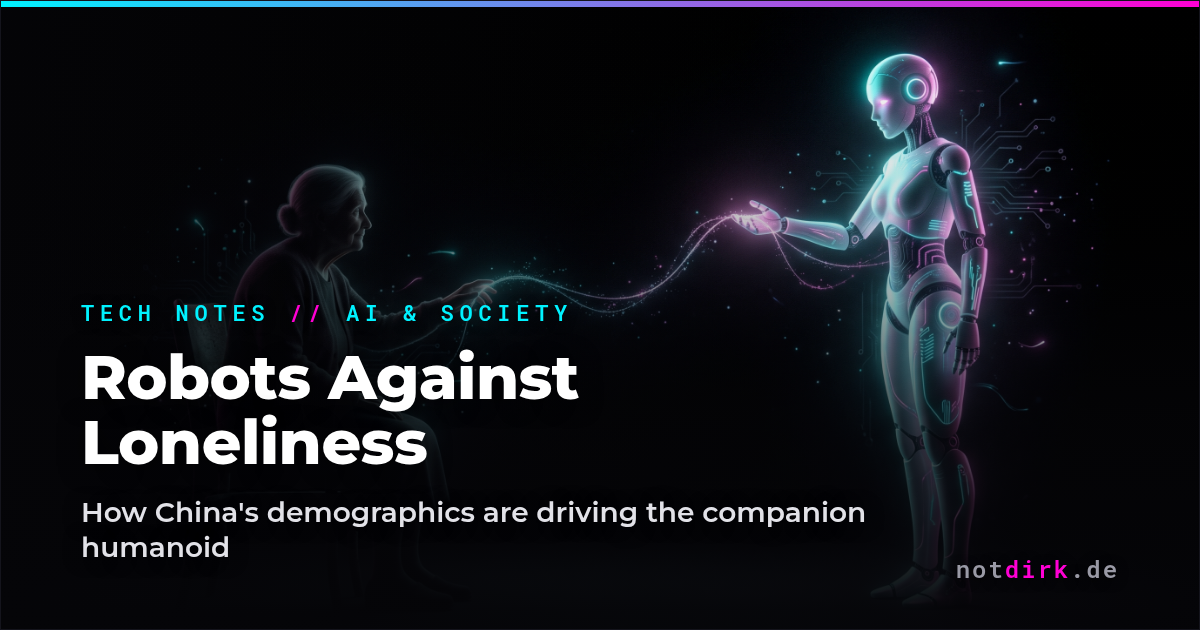
The Robot Against Loneliness
Listen to this article
Personal note
SavedStored only locally in your browser — nothing is sent.
In the previous issue I argued that China’s AI and robotics push doesn’t begin in the lab but in the population pyramid. This time I want to go one level deeper — to one that gets completely lost in the “China versus the US” frame: loneliness as a market. Because that is precisely how the new lifelike humanoid is being sold. And that positioning is the real news, not the silicone skin.
The demand is demographic, not cosmetic
Let’s start with the most extreme case. Hong Kong has one of the lowest birth rates in the world: the total fertility rate hit a low of 0.701 in 2022 and stood officially at 0.841 in 2024 — far below the replacement level of 2.1. Contrary to what is often claimed, this does not make Hong Kong the lowest worldwide: in the international 2024 comparison, only Macau (around 0.68) sits clearly below it, while South Korea (around 0.73) is roughly on par with Hong Kong — strictly speaking even a touch above. But Hong Kong unquestionably belongs to the top group. At the same time, life expectancy there is as high as almost anywhere: men live on average to 82.7, women to 88.2 (2024).
Few children, very old people — that is the basic equation that turns the companion robot into a business model. And it is no Hong Kong special case. China has been shrinking since 2022 for the first time in more than six decades; the number of over-60s crossed the 300-million mark for the first time in 2024, at 310 million (about 22 % of the population), with projections heading toward more than 400 million (28 %) by 2035. Germany is qualitatively on the same path: the fertility rate fell to 1.35 in 2024 and further to 1.32 in 2025; in 2024 around one in five people was 67 or older, and by 2035 it will be one in four. Even today, Germany has 33 people of retirement age for every 100 of working age.
The decisive thing is the second derivative: who will care for and accompany these elderly? For Germany, the Federal Statistical Office projects a gap of between 280,000 and 690,000 care workers by 2049. In China, a need for more than six million elderly-care workers faces only around 500,000 employed — of whom just about 330,000 work in long-term care. So the robot is not competing against the human — it is competing against the human’s absence.
Loneliness is a documented health problem — the robot as therapy is not
Here precision pays off, because this is exactly where fact and marketing tend to blur. That loneliness is a real, massive problem has, since 30 June 2025, ceased to be a gut feeling: on that day the WHO Commission on Social Connection released its report “From loneliness to social connection.” The core finding: worldwide, one in six people is affected by loneliness, linked to roughly 871,000 deaths a year — about 100 an hour. Adolescents and young adults are especially affected (around one in five), as are people in low-income countries (around one in four). So the need is there, quantified and urgent.
What the WHO report expressly does not establish: that a robot helps against it. And that is the fault line running through the whole subject. There is certainly encouraging data — the AI companion ElliQ, for instance, reported a 95 % reduction in feelings of loneliness among more than 800 users in a pilot programme run by New York State’s Office for the Aging, given active daily use (more than 30 interactions six days a week). On the other side stands the robot seal Paro: controlled studies show improvements in agitation and quality of life among dementia patients — but on anxiety the summarising meta-analysis found no significant effect. On top of that, the body of research has methodological weaknesses, and in some studies Paro did no better than a simple stuffed animal. Put honestly, this means: the driver is documented, the efficacy is open. Selling the humanoid as a proven answer to the WHO figures overstretches the evidence.
Where the capital flows — and where it doesn’t
That the industry considers this a business is legible in the money. According to PitchBook, the first quarter of 2026 was the strongest robotics quarter ever, with roughly 16.3 billion USD across 492 deals. An important caveat belongs here: that figure covers the broad “Robotics & Physical AI” category — including military autonomy mega-deals such as Saronic (1.75 billion) or Shield AI. So the sum is inflated by defence and does not cleanly measure the living-room robot. As a signal of the capital flood it still works, all the more so as European names appear in it too (Neura Robotics from Germany raised around 1.4 billion in June 2026).
And now the necessary sobering-up: on the capital side, companion robotics is a niche, not a centre. Goldman Sachs puts the global market for humanoids at 38 billion USD by 2035, Morgan Stanley sees more than a billion units by 2050 — but both expect these robots to be deployed overwhelmingly for industrial and commercial use, not as emotional companions — Goldman Sachs reckons that deliveries around 2030 will go almost entirely to industrial applications. The “biggest use case, loneliness” is the manufacturer’s narrative, not the consensus of market research. That China provides the stage for it, by contrast, is fact: the country accounted for around 54 % of all newly installed industrial robots worldwide in 2024. The industrial base from which a companion humanoid can even go into series production is there — the rest is a product decision.
The concrete product: UBTECH UWORLD U1
UBTECH has made exactly that product decision. The company — founded in 2012 and, since 29 December 2023, the world’s first publicly listed humanoid manufacturer on the Hong Kong exchange — presented the UWORLD U1 in Shenzhen on 30 June 2026, marketed as the “world’s first full-size, mass-produced ultra-bionic humanoid.” What of this is documented:
- The body. Bionic silicone skin, up to 88 degrees of freedom (servo joints), two sizes: the male version 183 cm tall, the female 168 cm. That is not a marketing round-off but backed by manufacturer specifications and the trade press.
- The positioning. Expressly as an “emotional companion” for everyday home life, according to UBTECH with the backing of Chinese authorities — and expressly not as a romantic or sexual partner. Sold only to adults aged 18 and over.
- The emotion AI. A locally running model (on a Rockchip RK3588 processor) is said to recognise around 20 emotional states from facial expression, posture and voice with over 90 % accuracy, and to hold conversations with eye contact. Notable, and against the cliché of the data hoover: UBTECH is actively promoting a “local-first” data architecture with minimal cloud connection — the data is meant to stay on the device. That is more a selling point than a risk, provided it holds.
And what is marketing, or critical:
- The price. The often-repeated range of “17,600 to 45,000 USD” is simply wrong at the upper end. The entry model (U1 Lite) is around 16,500 USD, the top model (U1 Ultra, male) sits at 990,000 RMB — roughly 136,500 USD, about three times the cited maximum. A mass-market companion looks different.
- The battery. After public criticism, UBTECH had to concede that such humanoids typically run for only two to four hours — “not through the night,” as critics note. For an everyday companion that is not a footnote but a core problem, one that is readily glossed over as a neutral specification.
- The sales figures. The much-cited more than 13,000 pre-orders on launch day come from UBTECH itself and are not independently verified; “sold out immediately” is an exaggeration. It is an order figure, not a verified sell-out. Delivery of early China orders: from mid-September 2026.
Where it gets uncomfortable
One detail deserves the sharpest framing. UBTECH announced it would donate a hundred customised U1 robots in 2026 — for elderly people living alone, children growing up separated from their parents, families in need. That sounds charitable. But the technical fit-out of these models gives pause: 3D facial reconstruction and voice-based identity replication — in plain terms: the robot can be styled as the likeness of a specific, possibly deceased, person. Western trade media such as TechRadar judge this feature, ethically, a clear no. I share the reservation. It is a qualitative leap from “device against loneliness” to “synthetic substitute for a particular person” — and this leap is sold as a product feature, not as what it is: a deep intervention into grief and attachment whose consequences no one has tested.
What this means for us
Three thoughts to take away:
- The demand is real, the product promise unproven. Demographics and loneliness are documented, hard realities — the efficacy of lifelike humanoids is not (yet). Equating the two confuses a market with a solution.
- The companion is the niche, not the trend. The big robotics capital flows into industry and defence. The living-room humanoid is the emotionally narratable part of a far more sober wave of investment.
- The real debate is not “too real.” Whether a robot looks convincing is the least interesting question. The interesting one is: do we want to organise loneliness away by technical means — and what do we do when the cheapest way out of the care crisis is, of all things, the one that digitally rebuilds a person who no longer exists?
For me, that is the punchline: the robot against loneliness is economically logical and humanly unanswered — and no spec sheet closes that gap.
If this piece made you think, feel free to share it — and sit with the question: would you accept a robot as a companion for an elderly relative if the alternative were no one at all?
Sources (selection):
- UBTECH press release on the UWORLD U1 (specs, positioning, donation, pre-orders): https://www.prnewswire.com/news-releases/ubtech-launches-uworld-u1-the-worlds-first-full-size-mass-produced-ultra-bionic-humanoid-robot-302815272.html
- SCMP – “Lifelike humanoid robots built for companionship” (emotion AI, positioning): https://www.scmp.com/tech/tech-trends/article/3358884/ubtechs-lifelike-humanoid-robots-built-companionship-arriving-homes-across-china
- humanoid.guide – UWORLD U1: prices (U1 Ultra 990,000 RMB male / 880,000 RMB female) and sizes (183 cm / 168 cm): https://humanoid.guide/ubtech-unveils-uworld-u1-humanoids-with-claimed-13361-orders/
- TechNode – 2–4 hours of battery life after criticism: https://technode.com/2026/07/06/ubtech-says-full-size-humanoid-robots-typically-run-for-only-two-to-four-hours-amid-u1-battery-criticism/
- TechRadar – ethical criticism of “robot replicas of loved ones”: https://www.techradar.com/ai-platforms-assistants/ubtech-just-introduced-its-first-full-size-ultra-bionic-humanoid-robot-but-what-it-really-wants-to-do-is-make-robot-replicas-of-loved-ones-thats-a-hard-no
- UBTECH press release – “first humanoid robot company listed on the Main Board of the HKEX” (debut 29 Dec 2023): https://www.prnewswire.com/apac/news-releases/as-walker-s-strikes-the-gong-ubtech-robotics-becomes-the-first-humanoid-robot-company-listed-on-the-main-board-of-the-hkex-302027943.html
- EqualOcean – “The first humanoid robot stock! Ubtech officially debuts on the Hong Kong Stock Exchange” (superlative, IPO 2023): https://equalocean.com/news/2024010520421
- Hong Kong Census & Statistics Department – fertility rate (0.701 / 0.841): https://www.censtatd.gov.hk/en/chat20250625.html
- Centre for Health Protection HK – life expectancy 2024 (82.7 / 88.2): https://www.chp.gov.hk/en/statistics/data/10/27/111.html
- Destatis – fertility rate Germany 2024 (1.35): https://www.destatis.de/DE/Presse/Pressemitteilungen/2025/07/PD25_259_12.html
- Destatis – fertility rate Germany 2025 (1.32): https://www.destatis.de/DE/Presse/Pressemitteilungen/2026/07/PD26_230_12.html
- Destatis (PE25_446, 11 Dec 2025) – 2024 around one in five people 67+, 2035 one in four: https://www.destatis.de/EN/Press/2025/12/PE25_446_12.html
- Destatis – care-worker gap by 2049 (280,000–690,000): https://www.destatis.de/DE/Presse/Pressemitteilungen/2024/01/PD24_033_23_12.html
- Fortune – China shrinks for a third year in a row; population aged 60+ at 310.31 million at end-2024 (about 22 %): https://fortune.com/asia/2025/01/17/china-population-fell-third-year-in-row-2024/
- Yicai Global – care-worker gap China (need >6 million, around 500,000 employed, of them ~330,000 in long-term care): https://www.yicaiglobal.com/news/robot-nurses-are-not-yet-ready-to-fill-aging-chinas-gap-of-millions-of-caregivers
- Fertility ranking 2024 (Macau ~0.68 / South Korea ~0.73, HK context): https://database.earth/population/fertility-rate/2024
- WHO – report on loneliness (1 in 6, 871,000 deaths/year): https://www.who.int/news/item/30-06-2025-social-connection-linked-to-improved-heath-and-reduced-risk-of-early-death
- New York State Office for the Aging – ElliQ pilot (95 % reduction): https://aging.ny.gov/news/nysofas-rollout-ai-companion-robot-elliq-shows-95-reduction-loneliness
- PMC / NCBI – meta-analysis of Paro in dementia: significant improvement in quality of life (SMD 0.35; p=0.007), NO significant effect on anxiety (SMD −0.08; p=0.71): https://pmc.ncbi.nlm.nih.gov/articles/PMC9292779/
- PitchBook – Q1 2026 Robotics & Physical AI VC (16.3 billion USD): https://pitchbook.com/news/reports/q1-2026-robotics-physical-ai-vc-trends
- Goldman Sachs – humanoid market 38 billion USD by 2035; deliveries around 2030 “almost all … for industrial use”: https://www.goldmansachs.com/insights/articles/the-global-market-for-robots-could-reach-38-billion-by-2035
- Morgan Stanley – humanoid market to 2050: https://www.morganstanley.com/insights/articles/humanoid-robot-market-5-trillion-by-2050
- IFR – World Robotics 2025 (China 54 % of new installations): https://ifr.org/ifr-press-releases/news/global-robot-demand-in-factories-doubles-over-10-years